• Posted on

Benefits of Botanical Skincare for Aging Skin

Benefits of Botanical Skincare for Aging Skin

Table of Contents

Last Updated: September 14, 2026

What Botanical Skincare Does for Aging Skin

Botanical skincare for aging uses plant-derived ingredients, seed oils, fruit extracts, leaf and root compounds, to support skin losing collagen, moisture, and resilience. The benefits come down to three jobs: defending against free radical damage, calming low-grade inflammation, and reinforcing the epidermal barrier.

At Giluxe, we build our formulas around that logic. Plant compounds such as flavonoids, phenolic acids, and carotenoids neutralize free radicals before they degrade collagen and elastin, and many soothe the redness that makes fine lines look deeper.

In aging skin, collagen production slows while trans-epidermal water loss rises, so skin looks thinner and feels tighter. Botanical extracts address both ends of that equation.

Cleveland Clinic overview of antioxidant effects on skin

Not every "natural" label earns its place. This guide covers which botanicals have real evidence, how to layer them with clinical actives, and the mistakes that cancel your results.

Best Botanical Ingredients for Wrinkles

The best botanical ingredients for wrinkles have both a documented mechanism and a stable delivery system. Green tea extract, rosehip seed oil, sea buckthorn, centella asiatica, and licorice root consistently appear in dermatological literature for antioxidant, anti-inflammatory, or pigmentation-related activity.

Here is how they differ in practice:

  • Green tea extract (EGCG): strong antioxidant activity against oxidative stress; best in serums and toners
  • Rosehip seed oil: rich in linoleic acid and vitamin A precursors; supports cellular regeneration and softens fine lines
  • Sea buckthorn: high in omega fatty acids and carotenoids; helps with barrier repair and dullness
  • Centella asiatica: soothing properties that suit reactive or sensitized skin
  • Licorice root: targets uneven pigmentation and age spots over time

These ingredients rarely fail because the plant is wrong, but because the formula is underdosed or the extract degrades before reaching your skin.

Synergistic Pairings That Outperform Single Botanicals

Most articles list botanicals in isolation, but the real advantage comes from pairing ingredients that reinforce each other's mechanisms. A few combinations have enough research to justify it:

  • Green tea extract + ferulic acid: Ferulic acid stabilizes EGCG and other catechins, slowing oxidation and extending antioxidant activity on skin, a pairing found in several well-known antioxidant serums.
  • Rosehip seed oil + sea buckthorn oil: Rosehip supplies linoleic acid for barrier repair while sea buckthorn contributes omega-7 fatty acids and carotenoids, addressing both the lipid barrier and oxidative stress, hence their presence in overnight repair oils.
  • Centella asiatica + licorice root: Centella calms reactivity while licorice root targets the pigmentation that often follows inflammation, addressing cause and consequence at once for skin prone to post-inflammatory hyperpigmentation.
  • Vitamin C-rich botanicals (e.g., kakadu plum, acerola) + soothing oils (e.g., jojoba, plant-derived squalane): The vitamin C precursor supports collagen synthesis while the oil buffers acidity that can irritate sensitive skin, common in brightening serums for reactive skin.

Formulators who understand these interactions usually name the pairing on the label. If a brand lists five botanicals but explains none of their relationships, the formula is a checklist, not a system.

Concentrations That Actually Show Results

Concentration is where botanical claims usually fall apart. A formula can list green tea extract and contain so little it acts as fragrance rather than an active.

Industry guidance treats standardized extracts as the benchmark, because they guarantee a measurable level of the active compound. Look for a stated percentage or standardized marker. If a botanical sits at the very end of the ingredient list, behind preservatives and fragrance, treat it as decorative.

What counts as a meaningful concentration varies by botanical, but a few reference points are widely cited in formulation literature:

  • Green tea extract (standardized to EGCG): Many studies use concentrations in the 2-5% range for antioxidant effects. Below 1%, the extract is unlikely to deliver meaningful free-radical defense.
  • Centella asiatica (standardized to asiaticoside): Cosmetic formulas often use 0.1-1% of the standardized extract. Higher percentages appear in products targeting barrier repair or scar management.
  • Licorice root (standardized to glabridin): Effective ranges for pigmentation support are often cited around 0.1-0.5% glabridin. Whole-root powders require much higher percentages to deliver the same active level.
  • Rosehip seed oil: As a carrier oil, it is typically used at 5-100% of the oil phase. Its benefit comes from fatty acid content, not a single standardized marker, so cold-pressed extraction and packaging matter more than percentage.

These ranges are not universal, and a well-formulated product can work below them if the delivery system improves penetration. But if a brand cannot tell you the concentration of its headline botanical, that is your answer.

Pro Tip Standardized extracts cost more to produce, which is why budget formulas often use whole-plant powders instead. A label that says "green tea extract" without a standardization marker is not necessarily ineffective, but it is unverifiable.

How to Read a Botanical Label Like a Formulator

Ingredient lists are ordered by concentration, but that order says more about the base formula than the actives. Practical checks:

  • Look for the active near the top third of the list. If it appears after preservatives (phenoxyethanol, sodium benzoate) or fragrance, it is likely present at less than 1%.
  • Check for a standardized marker. Terms like "standardized to 5% EGCG" or "0.2% glabridin" indicate the brand is measuring the active, not just the plant.
  • Note the extraction method when listed. Cold-pressed and CO2-extracted oils retain more fragile compounds than solvent-extracted versions.
  • Consider the packaging. Antioxidant-rich botanicals degrade in clear jars and dropper bottles exposed to light; opaque, airless, or amber glass signals that the brand understands stability.

None of these checks require a chemistry background, only that you read past the front of the bottle.

Botanical vs Synthetic Skincare for Aging

Botanical and synthetic skincare are not opposites, and treating them as such damages how people shop. Retinoids, vitamin C, and peptides are synthetic or semi-synthetic actives with the deepest clinical evidence for photoaging. Botanicals bring antioxidant breadth, soothing properties, and barrier support that synthetic actives often lack.

The honest comparison looks like this:

Approach Strength Limitation Best For
Botanical extracts Antioxidant defense, soothing, barrier support Slower visible change, variable potency Sensitivity, maintenance, layering
Synthetic actives Faster, measurable collagen and pigment change Irritation, photosensitivity, adjustment period Active fine lines, age spots
Combined routine Broad defense plus targeted correction Requires careful sequencing Most aging skin

Synthetic actives win on speed; botanicals win on tolerability and long-term nourishment. A routine built on one and ignoring the other leaves a gap.

American Academy of Dermatology guidance on anti-aging skincare

How to Build an Organic Anti-Aging Routine

An organic anti-aging routine works when sequenced by function, not product count: cleanse, treat with water-based actives, seal with oil-based botanicals, then protect with sunscreen every morning.
Add to cart →

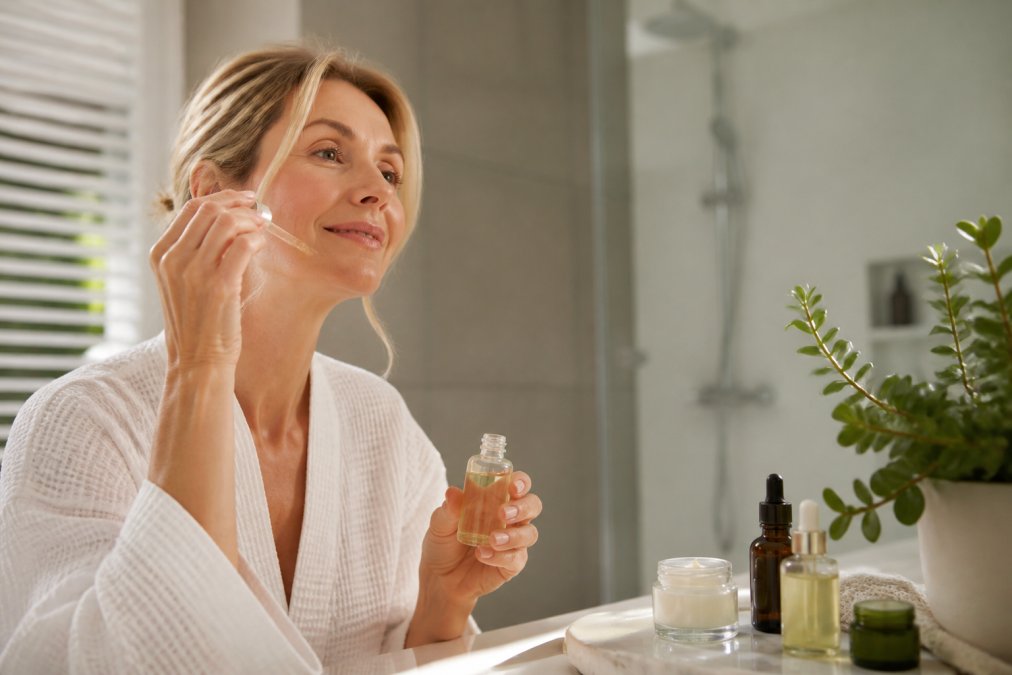
A woman in her 50s applying facial serum in a bright bathroom, botanical skincare bottles and a small green plant arranged on the counter beside her

Here is the sequence that holds up:

  1. Cleanse gently. A botanical cleansing bar removes buildup without stripping the barrier. Giluxe's Radiance Facial Cleansing Soap combines kojic acid, turmeric, jojoba oil, and tea tree oil to lift impurities and dead surface cells while supporting a more even-looking complexion.
  2. Treat on damp skin. Apply antioxidant serums while skin is still damp; absorption improves and you use less product.
  3. Layer botanical oils last at night. Oils sit on top of water-based layers and slow trans-epidermal water loss overnight.
  4. Protect every morning. Sunscreen is non-negotiable. Photoaging undoes botanical work faster than any serum can repair it.

Consistency beats intensity: a simple routine followed daily outperforms a complex one you abandon in two weeks.

Radiance Facial Cleansing Soap

Pairing Botanicals with Clinical Actives

Pairing botanicals with clinical actives is the biggest upgrade most routines are missing. The strategy: let the synthetic active do the correcting, and botanicals do the calming and defending around it.

The challenge: clinical actives like retinoids and alpha-hydroxy acids (AHAs) work best on clean, dry skin at a specific pH, while many botanical oils and serums sit at a different pH and can interfere with penetration or increase irritation if layered incorrectly. This is where most routines fail.

A practical framework for layering:

  • Retinoids (tretinoin, adapalene, retinol): Apply to clean, dry skin at night. Wait 10-20 minutes, then follow with a soothing botanical serum or oil (centella, green tea, or rosehip) to buffer reactivity. If your skin is sensitive, alternate nights rather than stacking.
  • AHAs and BHAs (glycolic, lactic, salicylic): Apply after cleansing and wait for the skin to return to its normal pH before applying anything else. Botanical antioxidants like green tea or ferulic acid can be applied after the acid has finished working, but avoid layering a heavy oil directly over an acid, as it can trap the acid against the skin and increase irritation.
  • Vitamin C (L-ascorbic acid): Apply in the morning on clean skin. Pair with a botanical antioxidant serum (green tea, ferulic acid) to stabilize the vitamin C and extend its activity. Follow with moisturizer and sunscreen.
  • Niacinamide: Generally well-tolerated with most botanicals. Can be layered before or after botanical serums depending on texture preference.

Irritation complaints are rarely caused by the active itself. They come from applying a strong active to a barrier that was never supported. Botanicals are the support system, not the correction system.

Watch Out Layering a strong exfoliating acid directly under a botanical oil can trap the acid against the skin and increase irritation. Space them out or alternate nights.

A Sample Weekly Schedule

If you are building a routine from scratch, a weekly schedule prevents overloading your skin while still delivering both botanical and clinical actives:

  • Monday, Wednesday, Friday (PM): Retinoid on clean, dry skin, followed by a botanical soothing serum after 15 minutes.
  • Tuesday, Thursday (PM): Botanical antioxidant serum (green tea, ferulic acid) layered under a barrier-repair oil (rosehip, sea buckthorn).
  • Saturday (PM): AHA or BHA exfoliation, followed by a centella-based calming serum once the acid has finished working.
  • Sunday (PM): Recovery night. Gentle cleanse, botanical oil, and nothing else.
  • Every morning: Gentle cleanse, vitamin C or botanical antioxidant serum, moisturizer, sunscreen.

This schedule is not rigid. The principle is to alternate correction nights with support nights so your barrier has time to recover.

What to Do When Your Skin Reacts

Even a well-built routine can cause irritation when you introduce a new active. If your skin stings, turns red, or flakes:

  • Stop the clinical active for 3-5 nights. Continue with gentle cleansing and a botanical barrier oil only.
  • Reintroduce the active at a lower frequency. Instead of every other night, try twice a week.
  • Check your layering order. If you applied the active and the botanical oil within a minute of each other, try waiting 15-20 minutes.
  • Simplify. A routine with five products is harder to troubleshoot than one with three.

Most practitioners find skin adjusts to retinoids and acids within 4-6 weeks when the barrier is supported. If irritation persists, the active may be too strong for your skin type, discuss a gentler alternative or lower concentration with a dermatologist.

American Academy of Dermatology guidance on anti-aging skincare

Common Mistakes That Undo Botanical Results

The most common mistakes with botanical skincare are not about the ingredients at all. They are about storage, order, and expectations.

  • Storing actives in direct sunlight. Antioxidants oxidize. A serum that turns brown has usually lost potency.
  • Applying oils before water-based serums. Oils block absorption of anything applied after them.
  • Expecting retinoid-speed results. Botanicals work on defense and barrier repair, which shows over weeks, not days.
  • Skipping sunscreen. Without it, pigmentation and fine lines return regardless of what else you use.
  • Buying on the word "natural" alone. Natural is not a regulated performance claim.

Treating a botanical product as a replacement for sun protection is a common mistake, no plant extract substitutes for it.

Sourcing, Sustainability, and What to Check on a Label

Sourcing transparency is the fastest way to separate a serious botanical brand from a marketing one. Plants vary by region, harvest, and extraction method, so origin directly affects how well an ingredient works.

Check these on any label:

  • Standardized extract vs. whole-plant powder: standardized means a guaranteed active level
  • Ingredient order: botanicals should appear before preservatives if they are meant to be active
  • Extraction method: cold-pressed and CO2 extraction preserve fragile compounds better than harsh solvent methods
  • Packaging: opaque, airless, or amber glass protects antioxidants from light and oxygen
  • Sourcing statement: a brand that names its suppliers is usually a brand that tests its inputs

Sustainability and sourcing transparency travel together: a brand that can trace its rosehip to a specific grower can usually also tell you how that grower farms.

Key Takeaway If a label lists a botanical but no concentration, no extraction method, and no sourcing, you are buying the story, not the active.

Aging skin needs defense, hydration, and consistency more than a shelf full of products. Giluxe builds botanical formulas around deep hydration and premium, thoughtfully sourced ingredients, from our Radiance Facial Cleansing Soap to our full facial care collection, designed to nourish and strengthen skin without heavy buildup. If you want a routine that supports your barrier instead of fighting it, start with Giluxe.

Facial Cleansing Soap

Frequently Asked Questions

Is botanical beauty better for your skin as you age?

Botanical skincare can be a strong fit for aging skin because plant extracts supply antioxidants, anti-inflammatory compounds, and fatty acids that address oxidative stress and trans-epidermal water loss, two drivers of visible aging. It is not automatically better than synthetic actives, though. Retinoids and peptides still have the deepest clinical evidence for collagen production. Botanical formulas work best as a nourishing base layer, with targeted actives layered on top where your skin tolerates them.

What are the most effective botanical ingredients for reducing fine lines?

Look for bakuchiol, which supports collagen production and has been studied against retinol with less irritation. Green tea and grape seed extracts supply antioxidants that limit free radical damage from UV exposure. Rosehip oil delivers vitamin A precursors and fatty acids that improve skin elasticity. Jojoba oil and shea butter strengthen the epidermal barrier and reduce moisture loss. A formula combining two or three of these outperforms a long ingredient list at token amounts.

Can botanical skincare provide the same results as synthetic anti-aging products?

Not identically, and the honest answer depends on the concern. For hydration, soothing sensitivity, and antioxidant protection, botanical formulas perform well and often with fewer irritation issues. For deep wrinkle remodeling, prescription retinoids and in-office treatments still lead on measured outcomes. Many dermatologists recommend a hybrid: botanical products for barrier support and daily antioxidant defense, clinical actives for collagen stimulation. Pairing them, rather than replacing one with the other, gives the best of both.

What should you look for in a botanical skincare label for mature skin?

Check the order of ingredients, since anything listed after the preservative is present in tiny amounts. Look for named plant oils and extracts rather than a vague botanical blend. Scan for beneficial additions like kojic acid, turmeric, tea tree oil, jojoba oil, and vitamin E, which support brightening and barrier repair. Confirm the packaging is opaque and airless, because antioxidants degrade in light and oxygen. Finally, look for third-party testing or certification if sensitivity is a concern.

Read Also

See all News
How to Hydrate Dry Skin Naturally at Home
  • Posted on
How to Hydrate Dry Skin Naturally at Home
Learn how to hydrate dry skin naturally at home with dermatologist tips, best natural oils, and foods that hydrate skin from within. Start your routine.
What Is the Healthiest Hair Care Brand?
  • Posted on
What Is the Healthiest Hair Care Brand?
Healthiest hair care brand: Discover what makes a truly healthy hair care brand. Learn about clean ingredients, scalp health, and botanical formulas that.
Best Luxury Organic Skincare 2026
  • Posted on
Best Luxury Organic Skincare 2026
Discover the best luxury organic skincare for 2026. Learn how to choose botanical formulas that work for your skin type. Explore now.
Lightweight Organic Hair Products for Coils
  • Posted on
Lightweight Organic Hair Products for Coils
Discover lightweight organic hair products for coils that hydrate without buildup. Learn botanical ingredients, porosity tips, and routines that work.
Best Organic Hair Products: 2026 Guide
  • Posted on
Best Organic Hair Products: 2026 Guide
Discover the best organic hair products for all hair types. Compare sulfate-free, plant-based formulas that reduce breakage and nourish scalp health.
Giluxe, Hair Care Products, and Deals. - Giluxe
  • Posted on
Giluxe, Hair Care Products, and Deals.
Discover the latest from Giluxe Luxury Organic Hair Care. Explore our nature-inspired hair essentials designed to nourish, hydrate, style, and enhance shine—plus enjoy exclusive deals and special offers created to elevate your self-care routine.