Your cart is empty
Tax included and shipping calculated at checkout

Drawer menu
Tax included and shipping calculated at checkout

Last Updated: August 29, 2026
A non-greasy hair serum for shine delivers lightweight hydration without heavy residue that leaves hair flat or weighed down. The difference between a serum that nourishes and one that clogs comes down to molecular weight and ingredient selection. A truly effective non-greasy serum uses lightweight emollients and humectants that work with your hair's natural porosity to deliver shine and softness without buildup.
Lightweight formulas work by matching molecular size to the hair cuticle's absorption capacity. Smaller molecules penetrate deeper, while larger ones accumulate on the surface, creating greasiness (peer-reviewed research). The best non-greasy serums blend lighter oils like jojoba or argan with silicone-free conditioning agents that provide slip and shine without residue.
Hair porosity plays a crucial role. High-porosity hair absorbs quickly but loses moisture fast, requiring humectants and sealing emollients (the American Academy of Dermatology). Low-porosity hair resists absorption, so formulas must be lighter and more dispersible. Botanical serums offer a distinct advantage: plant-derived emollients like rosemary, avocado seed, and ginger tend to be less occlusive than synthetic alternatives, providing conditioning benefits while maintaining breathability.
Lightweight oils like jojoba, argan, and sweet almond absorb into the hair shaft rather than coating it. These mimic the scalp's natural sebum, so hair recognizes them as nourishment rather than foreign buildup.
Silicone-free conditioning agents provide detangling and shine without waxy residue. Look for plant-based alternatives like vegetable glycerin or botanical extracts that smooth the cuticle without creating barrier buildup.
Antioxidant botanicals like rosemary, cinnamon, and clove support scalp health and add vibrancy to your hair's natural color without weight.
Proteins and amino acids (keratin, biotin) strengthen the hair shaft and reduce split ends, improving shine by making light reflect more uniformly. Lightweight versions integrate into the hair structure rather than coating it.
The combination matters most. A formula pairing lightweight oils with botanical extracts and minimal silicones will absorb better and feel fresher than one relying on heavy occlusives alone.
The most common mistake is using too much product. A non-greasy hair serum requires precision, the right amount on the right sections makes the difference between glossy and greasy.
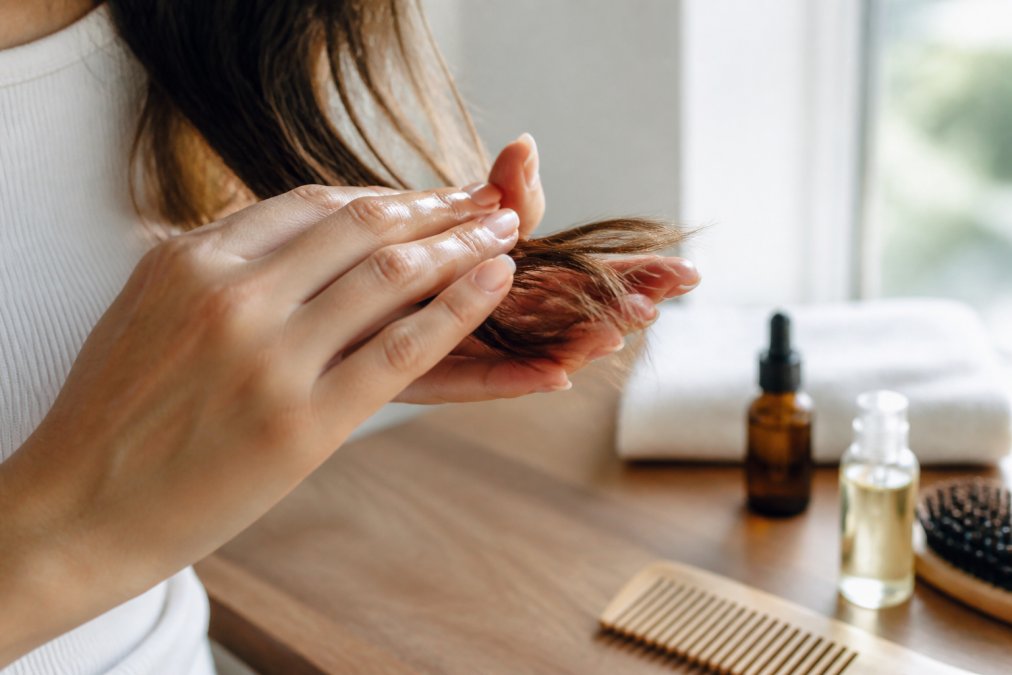
Start with a dime-sized amount (roughly half a teaspoon) for shoulder-length hair. For longer or thicker hair, use a nickel-sized amount. This is the single biggest factor in avoiding greasiness.
Apply to damp (not soaking wet) hair. Wet hair's open cuticles absorb product more efficiently, requiring less serum. Work from mid-length to ends, avoiding roots and scalp. The scalp produces its own sebum, and adding serum there creates immediate greasiness. Distribute by running your fingers through your hair in downward strokes, then use a wide-tooth comb to ensure even coverage.
For fine or thin hair, reduce to a quarter teaspoon and focus only on the ends. Fine hair has less surface area and absorbs products faster, needing even less product than thicker textures.
Straight and wavy hair benefits from serum applied to damp ends and worked through with a comb. These hair types need the least amount of product. Apply once or twice weekly for maintenance shine.
Textured and curly hair requires strategic application. Apply serum to soaking-wet hair before styling, working it through section by section with your fingers or a curl-defining brush. You can use slightly more product (up to a nickel-sized amount) because the curl pattern disperses it across more surface area. Serum acts as a frizz-control and definition aid alongside your leave-in conditioner.
Coily hair benefits from serum applied in smaller sections, working from roots to ends in downward motions. Coils are tighter and more prone to frizz, so serum helps smooth the cuticle. Start with a light hand and build gradually.
Heat styling changes how serum performs. Apply serum to damp hair before heat exposure, it provides heat protection and reduces thermal damage while helping the serum absorb faster.
When shopping for a best lightweight organic hair oil, you're looking for formulas that balance nourishment with absorption. Organic certification signals attention to purity and potency, but ingredient transparency and performance matter most.
Premium organic serums prioritize lightweight botanicals over heavy carrier oils. Look for:
Avoid formulas listing coconut oil, mineral oil, or heavy silicones as primary ingredients if greasiness concerns you. These work well for deep treatments but aren't suitable for daily, lightweight use.
Organic botanicals tend to have smaller, more bioavailable molecules than synthetic alternatives. Organic formulas typically exclude synthetic silicones, heavy emulsifiers, and chemical preservatives that accumulate on hair over time. The real differentiator is whether the brand prioritizes lightweight delivery.
Giluxe's approach emphasizes this balance. The Hydrating Tonic for Hair combines rosemary, ginger, cinnamon, clove, and avocado seed in a lightweight mist formula designed to hydrate without buildup, botanical nourishment that absorbs into the hair cuticle rather than sitting on the surface.
Use this checklist when evaluating serums to ensure you're choosing a formula that will deliver shine without greasiness:
Feature |
What to Look For |
Why It Matters |
|---|---|---|
Primary oils |
Jojoba, argan, sweet almond, avocado seed |
Lightweight, absorb into hair shaft |
Silicones |
Absent or minimal |
Avoid buildup and residue |
Humectants |
Vegetable glycerin, botanical extracts |
Draw moisture without occlusion |
Proteins |
Keratin, biotin, amino acids |
Strengthen hair and improve shine |
Botanical extracts |
Rosemary, ginger, cinnamon, clove |
Support scalp health and vibrancy |
Absorption time |
5-10 minutes when applied correctly |
Indicates lightweight formulation |
Hair suitability |
Explicitly mentions fine, textured, or all hair types |
Ensures compatibility with your needs |
Organic certification |
USDA or equivalent |
Signals purity and ingredient transparency |
Scent |
Light or unscented |
Heavy fragrance often indicates synthetic additives |
Packaging |
Dark glass or opaque bottle |
Protects botanical ingredients from degradation |
Before purchasing, check the ingredient list order. The first 3-5 ingredients determine the formula's character. If heavy oils or silicones appear first, the serum will likely feel greasy regardless of lighter ingredients listed later.
Different hair types need different serum strategies. Fine hair needs hydration without weight, while textured hair needs frizz control and definition without dryness.
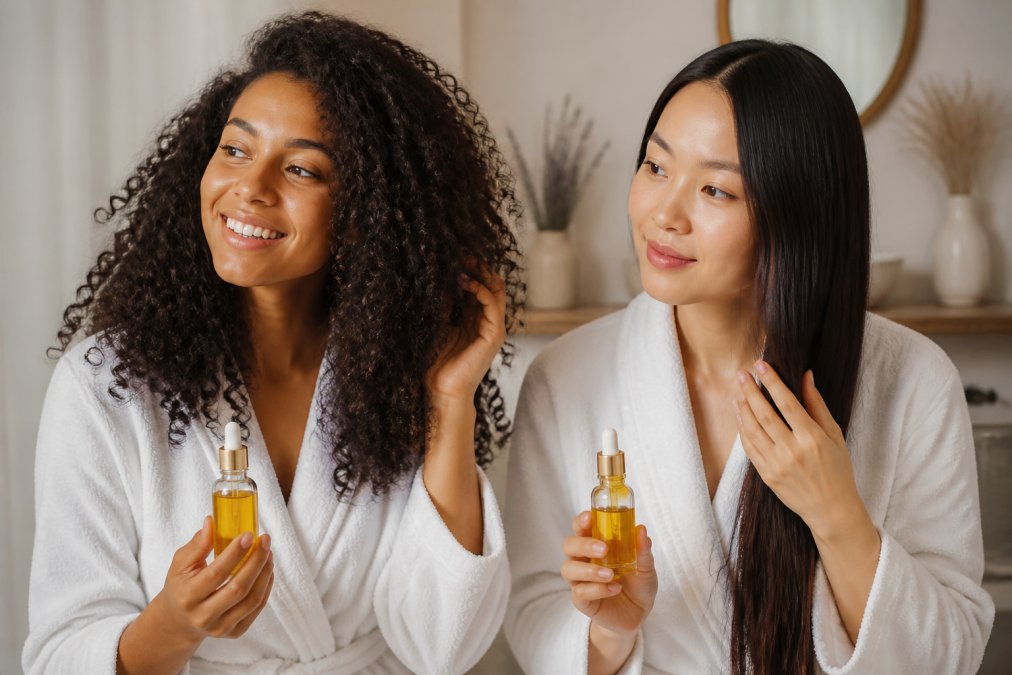
Fine hair has a smaller diameter and less density, so even lightweight serums can weigh it down if overused. The goal is to add shine and smoothness while maintaining volume and movement.
Use a quarter to half-teaspoon of serum, applied only to the ends. Fine hair produces enough natural sebum to keep roots hydrated, so concentrate product on mid-lengths and ends where damage is most visible. Apply to damp hair and allow it to air-dry or blow-dry on a lower heat setting.
For fine hair, prioritize serums with botanical extracts and minimal oil content. A hydrating mist or spray serum works better than an oil-based formula because it distributes more evenly and uses less product. The Giluxe Hydrating Tonic is specifically designed for this challenge, a lightweight mist that delivers hydration and shine to fine hair without the heaviness of traditional oils.

Fine hair benefits from weekly serum application rather than daily use. Once or twice weekly keeps fine hair looking glossy and healthy without sacrificing movement.
Textured and curly hair has more surface area and natural texture variation, absorbing more product without looking greasy. The challenge is preventing frizz while maintaining definition and hydration.
Apply serum to soaking-wet hair before styling, working it through section by section. Curly and textured hair benefits from serum applied as part of the styling routine, acting as a frizz-control base layer beneath your leave-in conditioner and styling cream. Use a nickel to dime-sized amount, depending on hair thickness and curl tightness.
For textured hair, look for serums with botanical ingredients that smooth the cuticle and reduce frizz. Rosemary, cinnamon, and ginger are particularly effective because they support scalp health and add vibrancy to curls. Protein-rich serums strengthen curls and reduce breakage, improving definition and shine.
Textured hair can benefit from 2-3 applications weekly. The curl pattern disperses product across more surface area, reducing buildup risk. However, pay attention to how your curls respond. If you notice residue or reduced definition, scale back frequency or reduce the amount per application.
Using too much product is the #1 reason serums feel greasy. Even the lightest formula will feel heavy with a full teaspoon or more. Start with a dime-sized amount and increase only if your hair visibly needs more.
Applying to wet hair instead of damp hair prevents proper absorption. Soaking-wet hair can't absorb serum efficiently because water occupies the space where serum would penetrate.
Applying to roots or scalp concentrates product where your hair already produces natural oil. Always start mid-length and work toward ends.
Using the wrong formula for your hair type is a setup for failure. Heavy serums work for thick, textured hair but will flatten fine hair. Read descriptions carefully and match the formula to your specific hair type.
Not waiting long enough between applications causes buildup. If your hair starts feeling heavy by day three, you're applying too frequently. Most hair types benefit from 1-3 applications per week, not daily use.
Choosing formulas with heavy silicones or mineral oil defeats the purpose of seeking a non-greasy serum. These ingredients accumulate on the hair shaft and are difficult to wash out.
The Giluxe Hydrating Tonic for Hair solves the core problem most shoppers face: how to get shine and hydration without greasiness. This lightweight mist combines rosemary, ginger, cinnamon, clove, and avocado seed in a botanical formula designed for absorption rather than occlusion.
The key difference is the delivery format. Rather than a traditional oil serum, the Hydrating Tonic is a spray that distributes evenly across your hair with minimal product. A few spritzes provide the hydration and shine of a heavier serum without the weight. It's formulated for all hair types, fine, textured, curly, straight, and color-treated, so you get one product that works across your entire household.
The botanical blend addresses multiple concerns simultaneously. Rosemary supports scalp circulation and adds vibrancy. Ginger and cinnamon provide antioxidant protection and help reduce frizz. Avocado seed oil delivers lightweight moisture without buildup. The formula absorbs within minutes, leaving only shine and improved manageability.
For fine hair, the Hydrating Tonic provides hydration without flatness. For textured hair, it delivers frizz control and definition. For all hair types, it refreshes tired hair between washes and adds a finishing shine layer after styling.
The Giluxe Hydrating Tonic & Pomade Duo pairs the Hydrating Tonic with a lightweight pomade for complete styling control. The tonic hydrates and refreshes, while the pomade provides hold and definition without stiffness or greasiness. Together, they deliver a premium hair-care experience that addresses both hydration and styling needs.

Achieving glossy, healthy-looking hair without greasiness requires understanding your hair's porosity, choosing the right lightweight formula, and mastering application technique. A non-greasy hair serum should feel like an invisible layer of nourishment, shine and softness without residue or weight.
Explore the Giluxe collection of botanical hair care products designed to deliver hydration, shine, and manageability for all hair types. The Hydrating Tonic for Hair and Hydrating Tonic & Pomade Duo provide the lightweight nourishment your hair deserves, with botanical ingredients that absorb completely and leave only luminous shine. Discover how premium, organic hair care can elevate your daily routine.
A non-greasy hair serum with lightweight botanical ingredients is your best option. Look for formulas containing emollients like argan or jojoba oil paired with humectants such as glycerin or panthenol. These absorb quickly into the hair cuticle, delivering hydration and luster without residue. Apply sparingly to damp hair, focusing on mid-lengths and ends rather than the scalp. Giluxe Hydrating Tonic uses fast-absorbing botanicals designed specifically to enhance shine while maintaining a weightless feel.
The key is using less product than you think you need. Start with 2-3 drops for fine hair, 4-5 for medium, and work it between your palms before applying to damp (not wet) hair. Apply from mid-shaft downward, avoiding the scalp and roots. For textured hair, work the serum through each curl or coil individually. Allow hair to air-dry or blow-dry on low heat. If your hair feels heavy, you've used too much. Lightweight formulas designed for non-greasy shine typically dry completely within minutes.
Avoid heavy silicones (dimethicone, cyclomethicone) and thick oils like coconut or mineral oil, which build up on fine strands and cause flatness. Skip serums with high concentrations of butters or waxes. Instead, choose serums with silicone-free, lightweight botanicals such as rosemary, ginger, or avocado seed extract that nourish without weight. Look for humectants that draw moisture into the hair without creating residue. Giluxe formulas prioritize absorption and manageability specifically for all hair types, including fine hair prone to buildup.
Both can deliver shine, but they work differently. Botanical oils absorb into the hair cuticle, providing nourishment and natural luster while supporting hair health. Silicones coat the surface, creating immediate smoothness and gloss but can build up over time. For a non-greasy finish with lasting benefits, lightweight botanical serums often outperform silicone formulas because they hydrate the hair structure itself rather than sitting on top. Choose botanical options with proven absorption rates if you prioritize lightweight feel and long-term hair health alongside shine.
The best serums combine emollients (which smooth the hair cuticle) with humectants (which lock in moisture) and botanical extracts known for frizz control. Look for formulas featuring keratin, biotin, rosemary, or ginger—ingredients that strengthen the hair structure and reduce flyaways while enhancing natural shine. A lightweight, non-greasy formula ensures frizz control without the heavy, flat appearance that thick serums create. Giluxe Hydrating Tonic addresses both concerns through its botanical blend designed to smooth cuticles and improve manageability while delivering a glossy, weightless finish.
This article was written using GrandRanker


