Your cart is empty
Tax included and shipping calculated at checkout

Drawer menu
Tax included and shipping calculated at checkout

Last Updated: August 13, 2026
Dry, brittle hair can occur when the hair lacks moisture and nourishing oils, leaving strands feeling rough and more prone to breakage. A botanical hair oil can help replenish moisture, nourish the scalp and hair, and improve the appearance of softer, stronger, healthier-looking strands.

At Giluxe, we formulate specifically for this challenge. Plant-based carrier oils mimic the sebum your scalp naturally produces, absorbing without buildup and reinforcing the protective barrier that keeps hydration locked in. Below, we'll cover which ingredients to look for, how to apply oil without creating buildup, and why hair porosity changes everything about which formula will work for your hair type.
Hair porosity is the hair's ability to absorb and retain moisture, determined by how open or closed the cuticle layer sits. Low-porosity hair has tightly closed cuticles, so oils tend to sit on the surface rather than penetrate. High-porosity hair, common in chemically treated or heat-damaged strands, has cuticles that are too open, moisture enters quickly but escapes just as fast.
Low-porosity hair benefits most from lighter oils such as argan and jojoba, which have smaller molecular structures and slip through tightly sealed cuticles. High-porosity hair responds better to heavier, occlusive oils like castor and olive, which seal the lifted cuticle and prevent moisture loss. Understanding your porosity is the first step to making any botanical hair oil actually work.
The ingredients in a botanical hair growth oil determine everything. Here are the key ingredients to prioritize:
A nutrient-dense formula combines several of these ingredients. Single-oil products rarely address the full spectrum of what dry hair needs.
Carrier oils interact synergistically. Castor oil alone is too thick and will not penetrate effectively without a lighter carrier like jojoba to thin it. Pair them together and add rosemary essential oil, and you have a formula that simultaneously stimulates circulation at the follicle level, nourishes the shaft, and seals the cuticle.
Vitamin E stabilizes the other oils in the formula, extending shelf life and enhancing their bioavailability on the scalp. This is why a thoughtfully blended botanical hair oil outperforms any single-ingredient oil. When evaluating any botanical hair growth oil, look for formulas where the ingredient list shows intentional layering: a penetrating carrier, an occlusive sealant, an active botanical for follicle stimulation, and an antioxidant stabilizer.
Essential oils are highly concentrated plant extracts that must be diluted before use. When blended correctly, they are among the most effective tools for scalp health and hair follicle stimulation.
Essential Oil |
Primary Benefit |
Best Paired With |
|---|---|---|
Rosemary |
Follicle stimulation, hair density |
Jojoba, argan |
Tea tree |
Scalp clarifying, anti-microbial |
Coconut, castor |
Peppermint |
Circulation boost, cooling sensation |
Argan, jojoba |
Lavender |
Scalp soothing, stress reduction |
Castor, olive |
Cedarwood |
Balances scalp oil production |
Jojoba, argan |
According to American Academy of Dermatology guidance on scalp care, a healthy scalp environment is foundational to supporting hair growth. Always ensure your essential oil infusion is properly diluted within a carrier oil base before application, undiluted essential oils cause irritation and can damage follicles.
Applying hair oil incorrectly is one of the most common reasons people abandon botanical treatments. For most hair types, two to four drops of oil is sufficient for a scalp application. More creates buildup that makes hair look dull and feel heavy.
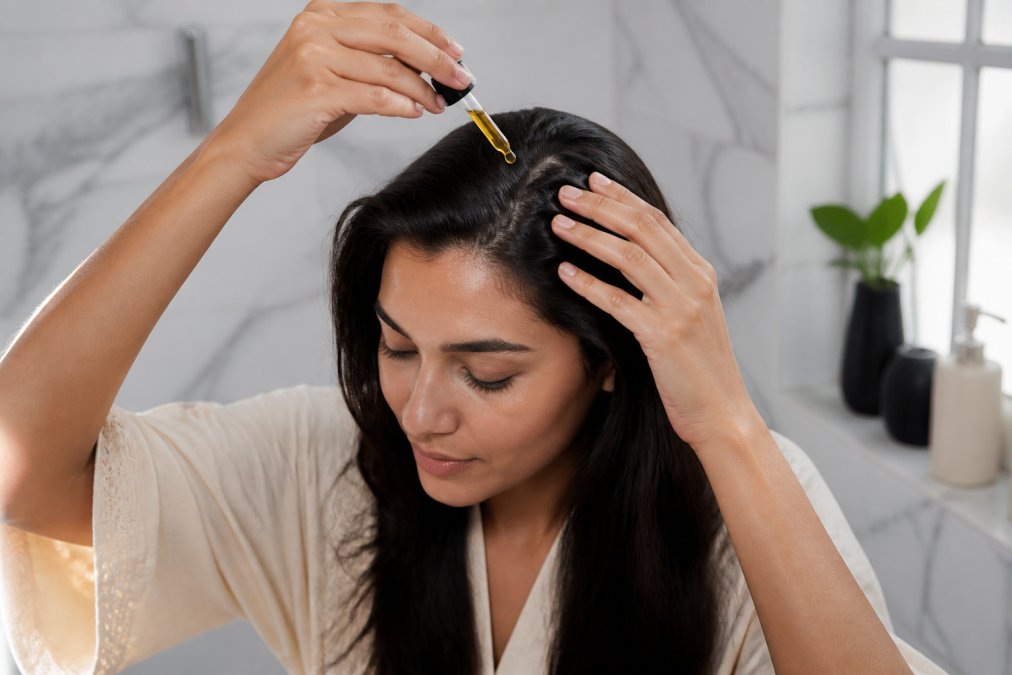
Step-by-step application for dry scalp:
Hair Type |
Recommended Frequency |
Best Application Method |
|---|---|---|
Fine, low-porosity |
Once per week |
Pre-shampoo treatment |
Medium, normal porosity |
2-3 times per week |
Scalp massage, mid-lengths |
Thick, high-porosity |
Daily or every other day |
Full-length application |
Coily, high-porosity |
Daily |
Sealing after water-based moisturizer |
Color-treated |
2-3 times per week |
Focus on ends and damaged sections |
Coily and high-porosity hair types generally benefit from daily oil use because the open cuticle structure allows moisture to escape rapidly. For fine or low-porosity hair, daily application leads to buildup and limp strands.
Hair oil does not produce overnight results. The hair growth cycle consists of three phases: anagen (active growth), catagen (transition), and telogen (resting). Botanical oils support the anagen phase by improving scalp circulation, nourishing follicles, and reducing breakage that makes hair appear to stop growing.
Most people using a botanical hair growth oil consistently begin to notice reduced breakage and improved hair texture within four to six weeks. Noticeable changes in hair density and length retention typically emerge after three to six months of consistent use. What you will likely notice first is not new growth but retained growth, hair that was previously breaking off now reaches lengths it could not sustain before.
As noted in Cleveland Clinic hair and scalp health resources, scalp health is directly tied to the hair growth environment, and improvements in scalp nourishment take several weeks to translate into visible hair changes.
The Giluxe Organic Hair Growth Oil is crafted with a botanical blend of nourishing oils designed to help moisturize the scalp and hair, reduce the appearance of dryness, and stands feeling softer, smoother, and healthier-looking without a heavy, greasy feel.
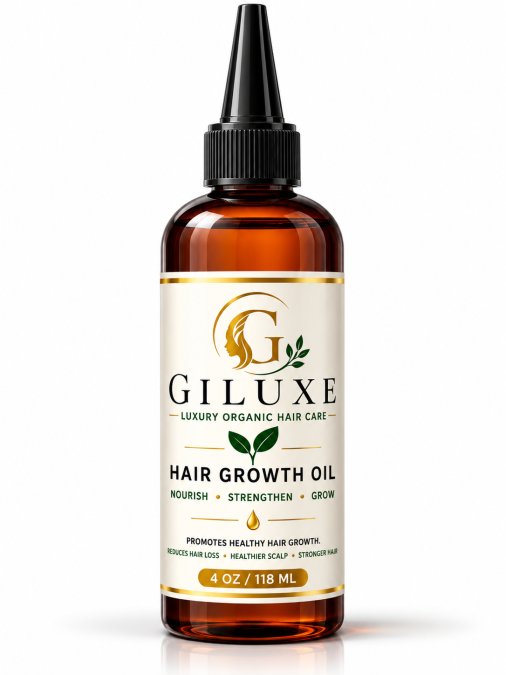
The formula includes rosemary, castor oil, olive oil, jojoba oil, argan oil, coconut oil, tea tree oil, and vitamin E, a layered combination that covers penetration, sealing, follicle stimulation, and antioxidant protection in a single product.
For those dealing with both dryness and breakage, the Giluxe Hydrating Tonic and Hair Growth Oil Duo ($42.98) pairs the oil with a botanical mist infused with rosemary, ginger, cinnamon, clove, and avocado seed. The tonic hydrates the scalp and refreshes hair between wash days, while the oil locks in that moisture and nourishes at the follicle level.

A consistent hair care routine can help dry hair feel softer, smoother, and more manageable over time. Combining moisturizing and nourishing products can help maintain hydration while supporting healthier-looking hair.
A practical botanical hair care ritual for dry hair looks like this:
Consistency is important when caring for dry hair. Regular use of moisturizing and nourishing products can help maintain hydration, improve manageability, and reduce the appearance of dryness and breakage over time.
Dry hair is a persistent challenge, and the wrong products make it worse over time. The Giluxe botanical hair growth oil collection was designed to work with your hair's natural biology, addressing porosity, lipid replenishment, and scalp health through botanicals that absorb without buildup. With the Giluxe Organic Hair Growth Oil and Hydrating Tonic available, building an effective routine is straightforward. Add to cart and start the ritual that dry hair has been waiting for.
For dry hair specifically, the most effective botanical hair growth oils combine carrier oils like castor, jojoba, and argan with scalp-stimulating botanicals such as rosemary. Castor oil supports hair density and moisture retention, while jojoba closely mimics the scalp's natural sebum for balanced hydration. A blend of complementary botanical oils can provide multiple conditioning benefits, helping nourish dry hair and support softer, healthier-looking strands.
Botanical hair oils can help nourish and moisturize the scalp and hair, support healthier-looking strands, and reduce the appearance of dryness and breakage. Ingredients such as rosemary and nourishing carrier oils are commonly used in hair-care routines to condition the scalp and help maintain stronger, healthier-looking hair. Results vary depending on hair type, routine, and individual factors.
How often you apply hair oil can depend on your hair type, scalp needs, and routine. For Giluxe Hair Growth Oil, apply to the hair and scalp three to four times per week for best results. Use an appropriate amount for your hair, gently massage it in, and adjust as needed based on how your hair and scalp respond.
Results vary from person to person depending on hair type, scalp condition, routine, and other individual factors. With consistent use, a botanical hair oil can help improve moisture, softness, manageability, and the appearance of healthier-looking hair. Hair growth takes time, so focus on maintaining a consistent hair-care routine rather than expecting results within a specific timeframe.
This article was written using GrandRanker


