Your cart is empty
Tax included and shipping calculated at checkout

Drawer menu
Tax included and shipping calculated at checkout

Last Updated: August 18, 2026
Coily hair demands a fundamentally different approach than other hair types. The natural spiral structure of coils means moisture travels down the strand differently, buildup settles unpredictably, and heavy formulas collapse curl patterns entirely. Lightweight organic hair products for coils are engineered to hydrate without flattening, nourish without residue, and deliver botanical benefits without the weight that suffocates definition.

Standard hair products were designed for straight hair. They deposit oils and silicones that coat the strand, which works on smooth surfaces but creates clumping and frizz on coils. Lightweight organic formulas use water-based delivery systems and plant-derived humectants that penetrate the coil structure rather than sitting on top of it.
At Giluxe, we've learned that botanical ingredients matter less than formulation: concentration, molecular weight, and ingredient order determine whether a product works. A heavy argan oil formulation, even if organic, will weigh down fine coils. But a water-based formula infused with jojoba and argan oil absorbs into the strand and delivers moisture where it's needed.
The Giluxe Organic Hair Growth Oil solves the central problem most people face with oils: absorption. Crafted with jojoba, argan, castor, and coconut oils alongside rosemary, tea tree, and vitamin E, this formula absorbs into the scalp and hair without leaving greasy residue. The lightweight texture allows daily use on fine coils without the buildup that comes with traditional hair oils.
What makes this work is the ratio of lightweight oils to heavier ones. Jojoba oil, which mirrors the scalp's natural sebum, absorbs quickly. Argan oil delivers moisture without heaviness. Castor oil provides breakage repair. Together, they address scalp health, moisture retention, and strand strength without collapsing coil definition.
For fine-textured coils, this oil works as a pre-shampoo treatment or lightweight leave-in serum. Apply to damp hair and it distributes evenly without clumping. At $24.99, it's positioned as a premium but accessible option for regular use.
Jojoba oil is the gold standard for coily hair because its molecular weight allows it to penetrate the coil structure without sitting on the surface. Argan oil provides secondary benefits: it's rich enough to deliver moisture but light enough that it doesn't accumulate with repeated use.
Jojoba's similarity to skin sebum means the scalp recognizes it as natural and allows absorption rather than rejection. Argan oil contains linoleic acid, which strengthens the hair shaft and reduces breakage. Together, they address the two biggest concerns for coily hair, moisture retention and structural integrity, without the buildup heavier oils create.
Coconut oil, often recommended for coils, is problematic for fine textures. It solidifies below 76 degrees and can accumulate in coils rather than absorb. It works for thick, densely coiled hair, but for fine coils, it's typically a mistake.
Water-based formulas that include jojoba and argan as secondary ingredients offer the best balance for daily use.
Hair porosity determines how quickly your coils absorb and retain moisture. High-porosity coils have a raised cuticle layer and absorb water quickly but lose it fast. Low-porosity coils have a tightly sealed cuticle, resist moisture absorption but retain it longer. Most coily hair falls somewhere in the middle, medium porosity.
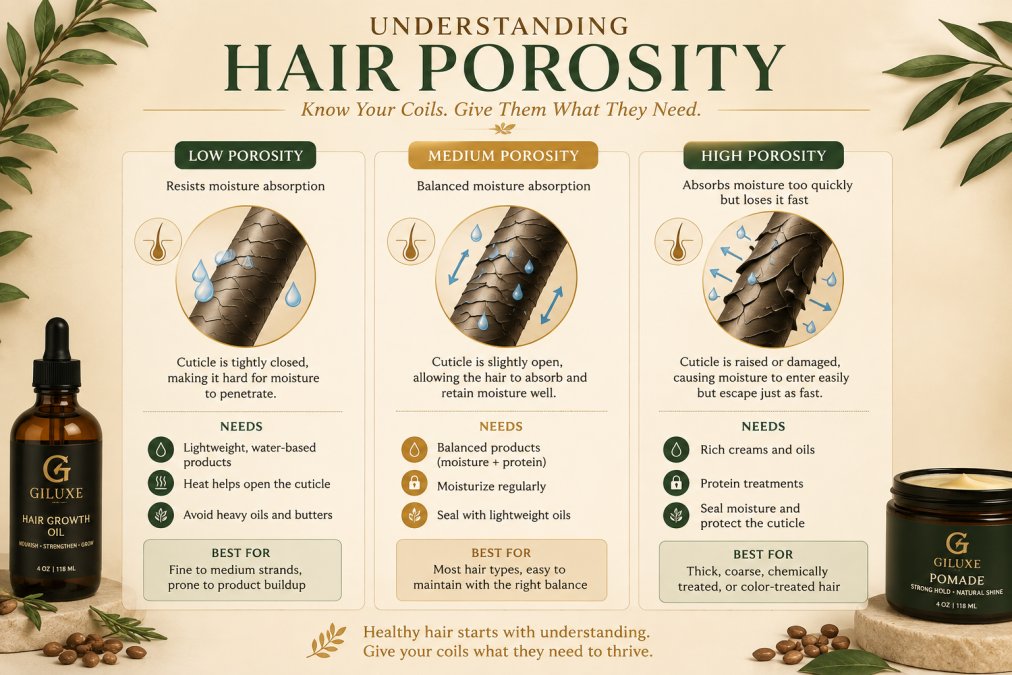
For high-porosity coils, lightweight formulas with humectants like glycerin and aloe vera work best. These ingredients pull moisture from the air into the coil. For low-porosity coils, lightweight water-based products penetrate better than heavy oils, and you need formulas that help water enter the coil structure rather than sit on top.
Fine-textured coils, regardless of porosity, need lightweight formulas because coil diameter determines how much product weight the structure can support. A product that works beautifully on thick coils will collapse fine coils entirely.
Understanding your coil pattern also matters. Tightly spiraled coils (4A, 4B, 4C patterns) have more surface area per strand and need more moisture but trap product easily. Looser coil patterns (3A, 3B, 3C) shed product more readily and can handle slightly heavier formulations. One-size-fits-all recommendations fail because coil structure is deeply individual.
Water-based formulas are the foundation of buildup-free coil care because water is the primary moisture your coils need. Oil-based products have their place as a secondary seal, not the primary hydration source. The mistake most people make is starting with oil, which prevents water absorption, then wondering why their coils feel dry.
The ideal sequence is water-based hydration first, then lightweight oil to seal. A hydrating tonic or leave-in conditioner with water as the first ingredient delivers moisture into the coil. Then a lightweight oil like jojoba seals that moisture in without blocking future water absorption.

Water-based formulas should contain humectants, glycerin, aloe vera, honey, and botanical extracts, that actively draw moisture into the coil. They're not just moisturizing; they're pulling moisture from the air into your hair structure. A lightweight water-based formula often outperforms heavy oil for actual hydration, even though oils feel more nourishing.
The buildup problem with oil-heavy alternatives comes from repeated application. Each time you apply heavy oil, a tiny layer remains. After weeks of daily use, those layers accumulate and your coils feel stiff, dull, and unresponsive. Water-based formulas don't accumulate the same way because water evaporates.
Silicones are the primary culprit in product buildup for coily hair. These synthetic polymers coat the hair shaft, creating initial smoothness but accumulating over time. Look for products labeled "silicone-free", this is non-negotiable for coils.
Sulfates strip natural oils from the scalp, triggering overproduction of sebum as compensation. For coily hair, this means your scalp gets greasy while your coils stay dry. Sulfate-free cleansing is standard now, but it's worth checking.
Heavy waxes and butters also cause buildup. Shea butter and cocoa butter are excellent for moisture but accumulate in high concentrations. Look for products where these ingredients appear later in the ingredient list, not in the first three items.
Lightweight organic hair products for coils avoid these accumulation issues by using lighter emollients, jojoba oil, argan oil, aloe vera, as primary conditioning agents rather than heavy butters.
A lightweight hydrating mist is the most underrated tool in coil care. Unlike heavy creams or oils, a mist delivers water directly to your coils throughout the day, refreshing curl definition without buildup. The Giluxe Hydrating Tonic for Hair ($21.99) is formulated with botanical extracts like rosemary, ginger, and cinnamon that support scalp health while delivering instant hydration through a water-based spray.
The advantage of a mist over a cream is frequency of use. You can reactivate your coils multiple times daily without concern about product accumulation. A spray bottle allows you to target specific areas where definition fades or dryness concentrates.
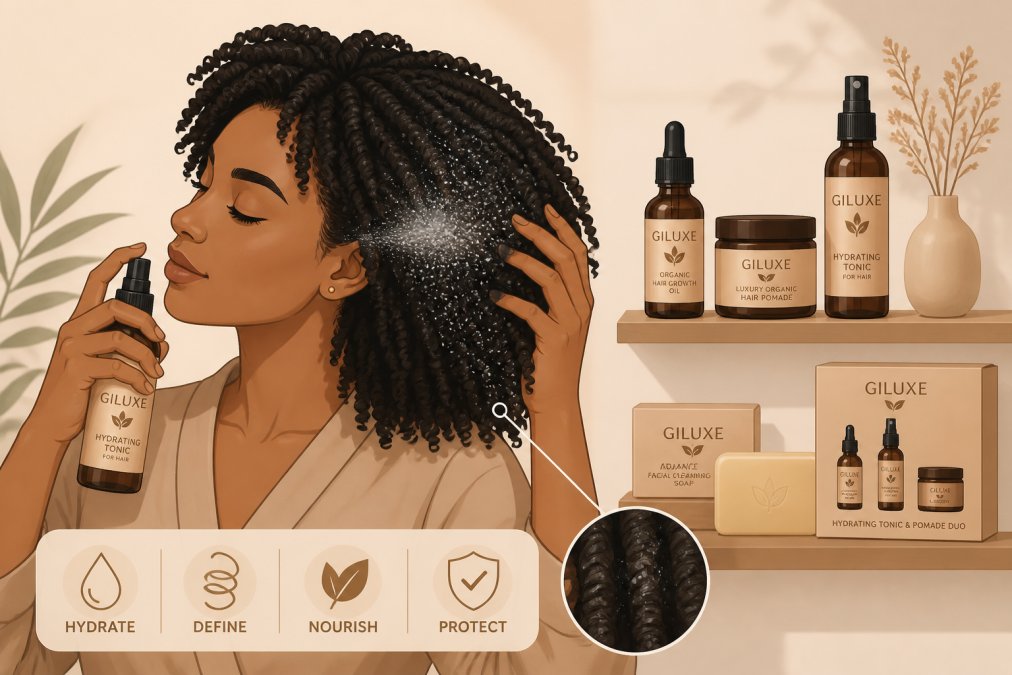
Rosemary supports circulation to the scalp. Ginger and cinnamon have warming properties that support scalp health. Avocado seed extract provides lightweight moisture. These ingredients work synergistically in a water-based formula to refresh your coils without the heaviness of oils or creams.
Spray the mist onto damp or dry coils, then use your fingers or a wide-tooth comb to gently distribute it. The moisture reactivates your curl pattern, and the botanical extracts provide lightweight conditioning. For fine coils, this is often enough for daily maintenance.
Once weekly, your coils benefit from deeper moisture penetration than a daily mist provides. The Giluxe Organic Hair Growth Oil works beautifully as a pre-shampoo treatment: apply it to damp hair, leave it for 15-30 minutes, then shampoo as normal.
Pre-shampoo on damp hair rather than dry hair means the oil penetrates the coil structure before shampooing removes it. The moisture your coils absorb during this treatment stays in the strand even after rinsing.
Scalp nourishment is equally critical. A healthy scalp produces natural sebum that travels down the coil, providing natural conditioning. Botanical oils applied directly to the scalp support this process. Massage the oil into your scalp with your fingertips, focusing on tight or dry areas. Leave it for at least 30 minutes before shampooing.
A weekly scalp treatment with lightweight botanical oils keeps your scalp healthy, which means your coils have better natural conditioning from the root.
The Giluxe Luxury Organic Hair Pomade ($19.99) delivers styling hold without collapse. It provides enough hold to define and shape your coils while remaining lightweight enough that it doesn't flatten them. The formula includes jojoba oil, argan oil, and castor oil alongside shea butter, which means you get conditioning and hold without stiffness.

Many styling products claim to work for coils but actually weigh them down. A true coil-specific pomade has a soft texture that allows movement rather than a stiff, flaky finish. The Giluxe formula absorbs into the coil rather than sitting on top.
For styling, use a small amount (roughly the size of a dime for a full head) and work it through damp hair with your fingers or a styling brush. Damp, not wet or dry, is the sweet spot. For fine coils, less is always more with styling products. Start with a smaller amount than you think you need.
Jojoba oil is the foundation of effective lightweight formulas for coils. Its molecular structure allows it to penetrate the coil rather than coat it. Argan oil provides secondary benefits, rich enough to nourish but light enough for daily use. Castor oil addresses breakage and strand strength, critical for coils that experience styling stress.
Rosemary extract supports scalp circulation and has antimicrobial properties that prevent buildup. Tea tree oil addresses scalp health and reduces fungal overgrowth that contributes to product accumulation.
Glycerin and aloe vera function as humectants, actively drawing moisture into the coil structure. These ingredients are essential in water-based formulas because they deliver actual hydration.
Vitamin E protects against oxidative stress and supports coil health. Coconut oil, despite its popularity, is problematic for fine coils because it solidifies below 76 degrees and can accumulate.
The ingredient order matters as much as the ingredients themselves. For lightweight organic hair products for coils, jojoba and argan should appear in the first three ingredients, with heavier butters appearing later if at all.
Coily hair deserves products engineered specifically for its structure, not generic formulas adapted to work "for all hair types." Giluxe's botanical collection, the Hydrating Tonic for Hair ($21.99), Luxury Organic Hair Pomade ($19.99), and Organic Hair Growth Oil ($24.99), addresses the core needs of coil care: lightweight hydration, scalp nourishment, and styling hold without buildup. These products work because they prioritize coil structure itself, using water-based delivery systems and carefully calibrated botanical oils that absorb rather than accumulate. Start with the Hydrating Tonic for daily refresh, add the Hair Growth Oil for weekly deep conditioning, and finish with the Pomade for definition. This routine transforms coil care from a frustrating battle against buildup into a sustainable practice that honors your hair's natural structure.
Lightweight botanical hair products are formulated to moisturize and nourish coils without leaving them feeling overly heavy or greasy. Look for formulas featuring ingredients such as jojoba oil, argan oil, rosemary, and other plant-based ingredients. For coily hair, a lightweight formula can help maintain moisture, softness, curl definition, and natural movement without excessive product buildu
Check the ingredient list and choose a formula suited to your hair's texture, porosity, and moisture needs. Start with a small amount and observe how your hair responds. If your coils begin to feel heavy, greasy, stiff, or coated after repeated use, reduce the amount or frequency. Fine coils often benefit from lighter applications, while thicker or denser coils may require more product.
I would change the question slightly because calling Giluxe “the best” is difficult to substantiate.
Start with gentle cleansing followed by lightweight hydration. Apply Giluxe Hydrating Tonic to help refresh and moisturize your coils, then use a small amount of Giluxe Hair Growth Oil to help seal in moisture. Adjust the amount and frequency based on your hair's texture, density, and porosity. Avoid over-applying products, which can leave coils feeling heavy or greasy.
Not necessarily. Organic certification verifies that certain ingredients or products meet specific organic standards, but certification alone does not determine how well a hair product will work for coily hair. Formula, ingredient quality, hair porosity, texture, and individual moisture needs are also important. Choose products based on their ingredients and how your hair responds to them.
This article was written using GrandRanker


